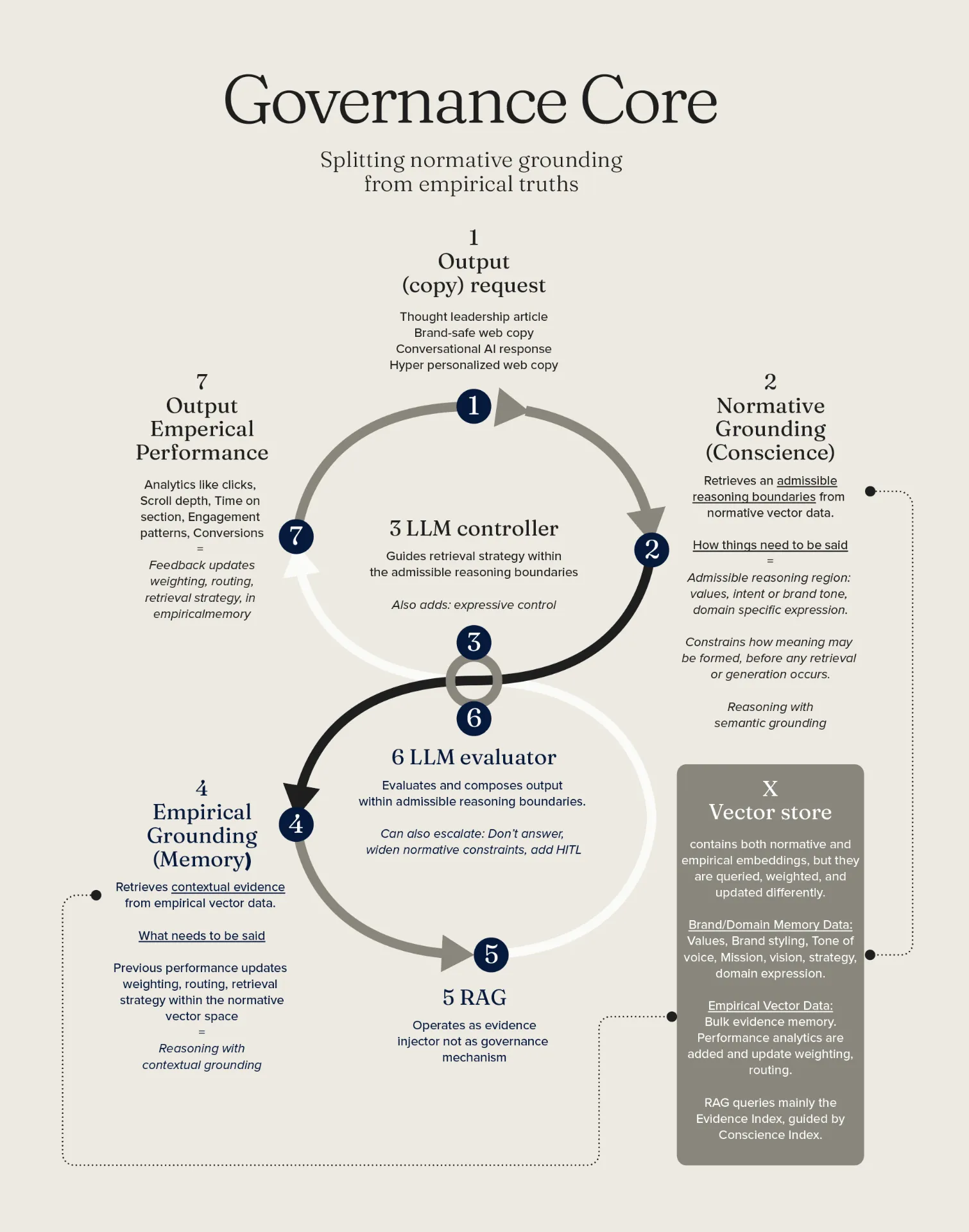
G-core represents a fundamental shift in how we design and control generative AI systems. Instead of treating the large language model as the primary source of intelligence, G-core reframes AI as a reasoning system constrained by meaning, governance, and context.
At its core, G-core introduces a “meaning-before-generation” paradigm. Traditional GenAI pipelines rely heavily on prompting and retrieval (RAG) to influence output. But in G-core, the process begins earlier—by defining an admissible reasoning space. This space is constructed from normative data: brand values, tone of voice, policies, and domain-specific expression rules. It determines how meaning is allowed to be formed before any evidence is retrieved or any text is generated.
Only within this bounded space does the system proceed to retrieve empirical data—facts, claims, and supporting evidence. This separation between normative grounding (how things should be said) and empirical grounding (what should be said) is critical. It ensures that retrieval is not just relevant, but also appropriate. RAG, in this context, becomes an evidence injector, not a governance mechanism.
The LLM itself is repositioned into two distinct roles. First, as a reasoning navigator, it determines what to retrieve and how to interpret it within the admissible boundaries. Second, as a constrained evaluator, it validates and composes the final output, ensuring alignment with intent, policy, and context—and escalating when necessary. This creates multiple bounded reasoning steps, rather than a single opaque generation process.
Within the broader GenAI strategy map, G-core functions as the runtime governance layer—the point where all prior investments in asset intelligence, context assembly, and governance converge. It operationalizes the idea that AI should not be controlled through prompts alone, but through a governable system layer: one that defines admissible spaces for expression, evidence, and intent.
This has significant implications. It allows organizations to scale AI without retraining models, by adjusting policies, constraints, and context instead. It enables auditable AI, where every output can be traced back to its sources and governing rules. And it transforms content systems from static libraries into dynamic meaning engines, where corporate knowledge, brand identity, and performance feedback continuously shape future outputs.
Ultimately, G-core is not about improving generation quality in isolation. It is about ensuring that every generated output is context-aware, policy-aligned, and explainable by design. In doing so, it moves generative AI from a creative tool to a controlled system of reasoning at scale.