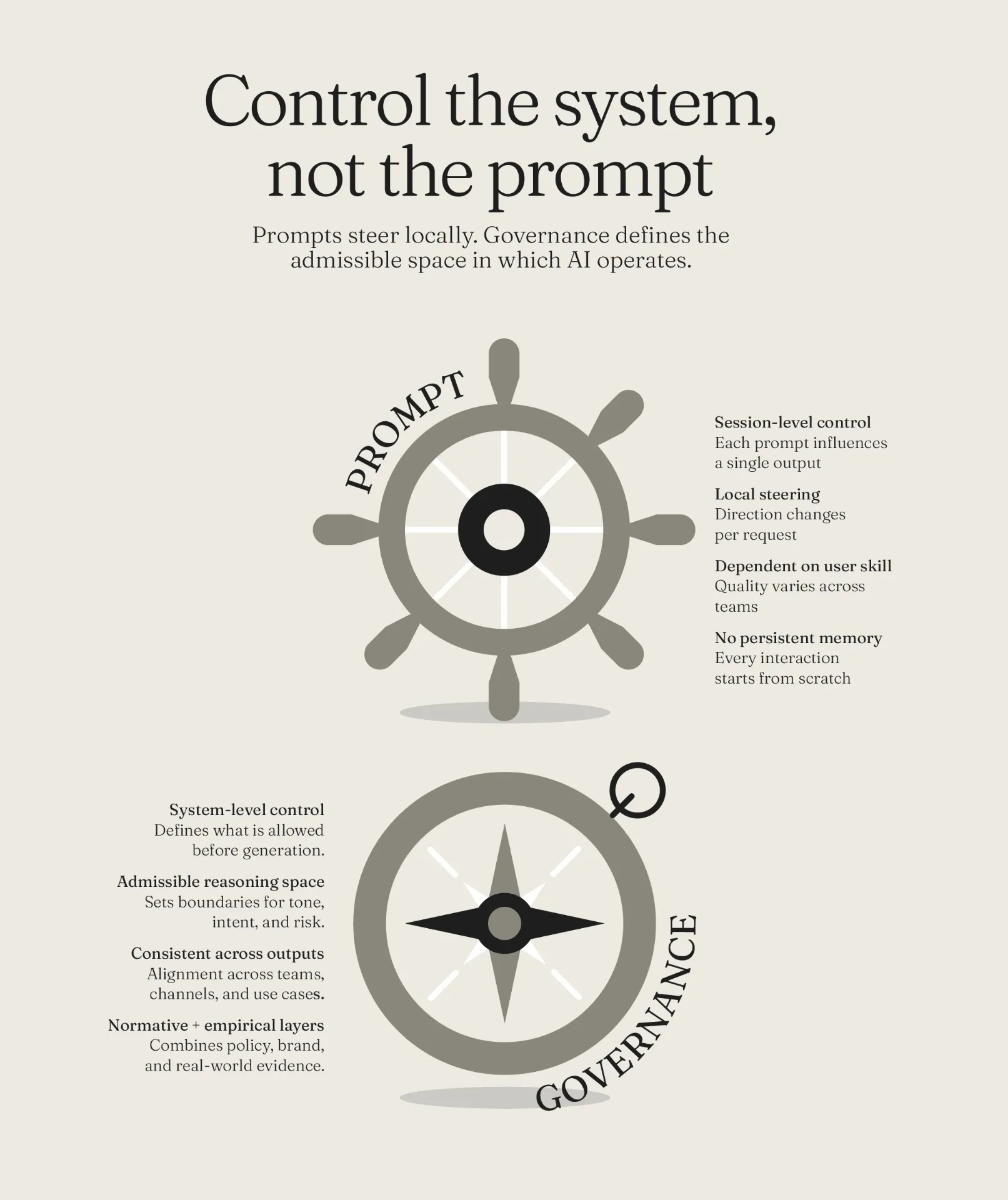
Most conversations about AI content still start with prompts. Better prompts. Smarter prompts. Longer prompts. But prompts are not the real problem.
The real problem is that content is no longer just generated, it is decided. And decisions without governance inevitably drift.
The illusion of control
Prompts feel comforting because they resemble instructions. They give the impression that if we phrase things carefully enough, the output will behave.
In practice, prompts are fragile. They depend on:
- Who writes them,
- When they are written,
- What context happens to be present,
- How the model interprets intent at that moment.
This is why many teams recognize the symptoms:
- Content that sounds right but feels off,
- Outputs that are technically correct but strategically misaligned,
- Subtle brand drift that accumulates over time,
- Risk appearing not as errors, but as inconsistencies.
These are not prompt problems. They are governance problems.
From generation to intent
Human content creation rarely starts with wording. It starts with intent: Why does this exist? Who is it for? What should it do? What must it not do?
Generative AI, by default, skips this layer. It predicts plausible output, not appropriate outcome.
Without an explicit intent layer:
- Relevance becomes accidental,
- Consistency becomes manual,
- Quality becomes subjective.
Governance reintroduces intent as a first-class constraint. Not as a prompt instruction, but as a structural condition.
On brand is not a style problem
Brand is often reduced to tone of voice or visual rules. In reality, brand is about allowed decisions. What can be said? What cannot? What trade-offs are acceptable? What patterns are preferred? Without governance, AI treats brand as decoration. With governance, brand becomes a boundary.
This is the difference between:
- Content that looks on brand,
- Content that behaves on brand.
On risk is not about fear
Risk in AI content is rarely dramatic. It is cumulative. Small inconsistencies. Unverified claims. Missing disclaimers. Overconfident phrasing. None of these break things immediately. But together, they erode trust.
Inconsistencies, together, erode trust.
Governance does not eliminate creativity. It eliminates unbounded creativity and creates a safe landscape where creativity can occur. By making constraints explicit, risk becomes something the system can reason about, instead of something humans have to clean up afterwards.
Why governance scales (and prompts don’t)
Prompts scale linearly. Every new use case needs new instructions. Every new team needs alignment. Every exception adds complexity.
Governance scales structurally. Once intent, domain rules, and risk boundaries are defined:
- Content becomes more consistent by default,
- Teams need fewer corrections,
- Systems improve as they are used.
This is not about replacing humans. It is about moving human judgment upstream.
The shift
The shift is subtle but fundamental: From asking “How do we prompt better?” To asking “What decisions should never be left implicit?”
AI content that is:
- On brand,
- On intent,
- And on risk
is not the result of clever wording. It is the result of explicit governance.
And governance, unlike prompts, compounds.