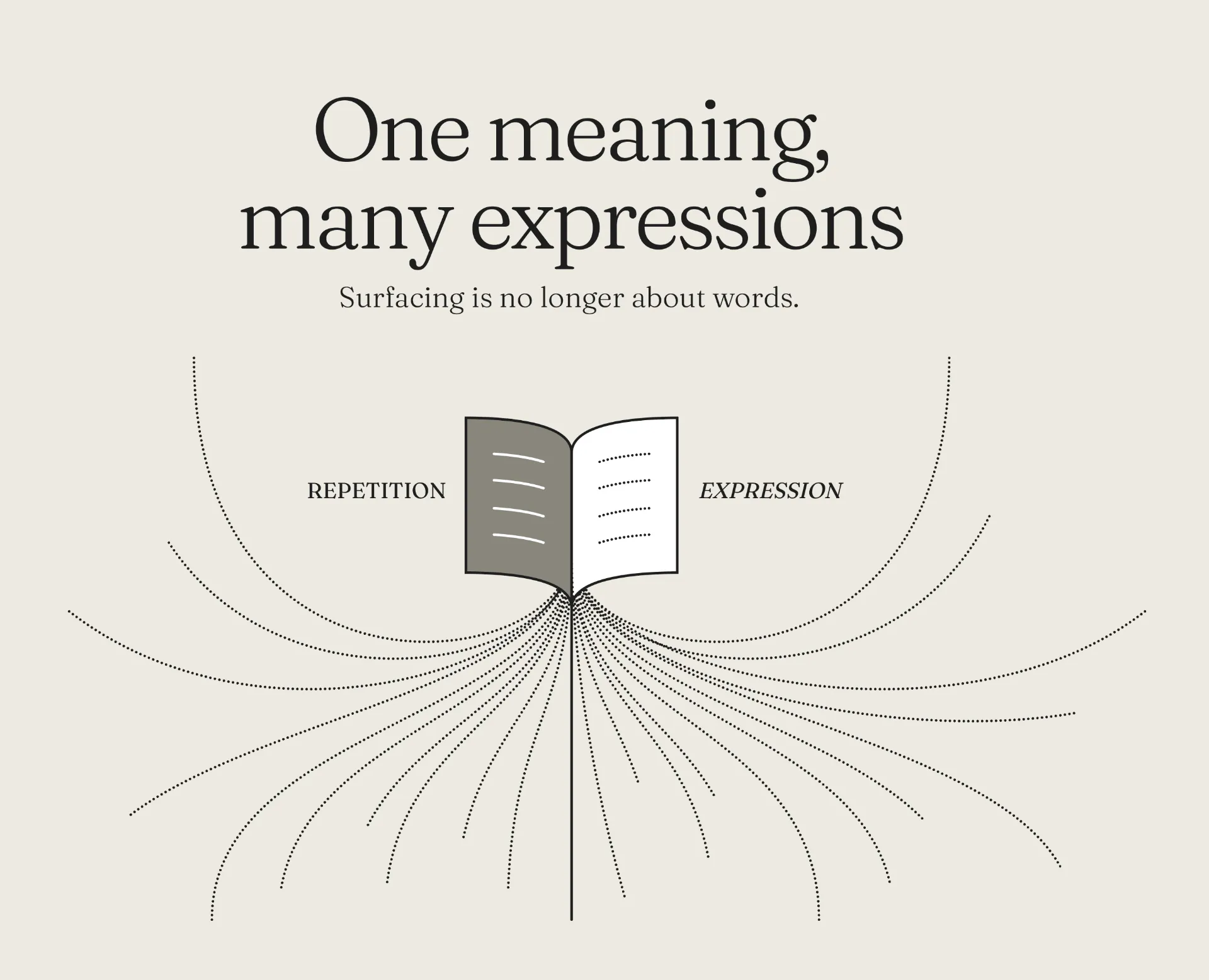
For years, search optimization was mostly about matching words. You chose a keyword and repeated it in strategic places: the title, headers, body text and meta description. The goal was simple: if someone searched for content marketing software, you wanted that exact phrase to appear clearly on your page.
Traditional search engines relied heavily on this kind of keyword matching. But AI-powered search is changing that.
From matching words to matching meaning
Modern search systems, from ChatGPT and Claude to Gemini, rely increasingly on semantic understanding. Instead of matching exact words, they try to understand what a question actually means.
For example:
- What is content marketing software?
- Which tools help manage marketing content?
- Software to create marketing materials faster
These questions use different words, but refer to roughly the same concept. That leads to a simple shift: SEO optimized for matching words. AEO optimizes for matching meaning.
Or even more simply: Optimizing for meaning = optimizing for understanding.
Why synonyms and clear explanations matter
Because AI systems retrieve information based on meaning, it helps when a concept is described in multiple natural ways. Not keyword repetition, but semantic clarity.
For example, a platform might be described as:
- An interactive document platform
- Software for creating digital reports and proposals
- A tool for replacing static PDFs
These descriptions reflect how different people think about the same solution. That variety makes it easier for AI systems to recognize the concept behind your content.
Why marketing language often hurts discoverability
Many marketing websites rely heavily on abstract phrases like:
- Powering next-generation engagement
- Unlocking digital transformation
These may sound impressive, but they often fail to explain what something actually is or does. For humans, this can already feel vague. For AI systems trying to retrieve information, it becomes even harder. Clear language almost always performs better than clever language.
A principle we already know: accessibility helps
Interestingly, one of the best-known web principles also helps here: accessibility. Websites that are structured for screen readers, with proper headings, clear structure, descriptive links and logical reading order, are easier to navigate for people using assistive technology.
They are also easier for machines to interpret.
In a way, an AI system processes a page a bit like a screen reader: it moves through the structure of the content and tries to understand relationships between sections. So practices that improve accessibility and structure often improve AI discoverability as well.
The new goal for content
Instead of optimizing pages for a single keyword, the goal is becoming much simpler: Make sure your content clearly explains what the concept it is about. Because in the age of AI search, content that is easy to understand is also the content that is easiest to find.
And this doesn’t just apply to public content. If you’re using your own content as input for AI systems, the same principle holds: Clear, well-structured content leads to better outputs.
The human side of AEO
There is also a reassuring conclusion in all of this. Content that is easier for AI systems to understand is usually the same content that is easier for people to understand. Clear language, logical structure, descriptive headings and concrete explanations have always been good practices.
We’re entering a new era. Visibility is no longer the goal, understanding is.