We’ve seen the pattern.
First, we optimized for keywords.
Then we optimized for meaning.
Then we optimized for structure.
Now there’s a next step.
The real limitation
AI doesn’t use pages. It doesn’t read documents from beginning to end. It breaks content apart into fragments, claims, and pieces of meaning. Then it tries to assemble those into something useful.
If those pieces are vague, inconsistent, or implicit, the output becomes unreliable. Not because the model is weak. Because the content layer is weak.
The mismatch
Inside most organizations, content still lives:
- In documents
- In slides
- In folders
- In people’s heads
Meaning is implicit. Context is assumed. Ownership is blurry. That works for humans. It doesn’t scale for AI.
The consequence
Without structure:
- Retrieval becomes unreliable
- Outputs become inconsistent
- Personalization becomes risky
- Trust erodes
AI doesn’t fail because of lack of data. It fails because of lack of structured meaning.
The shift
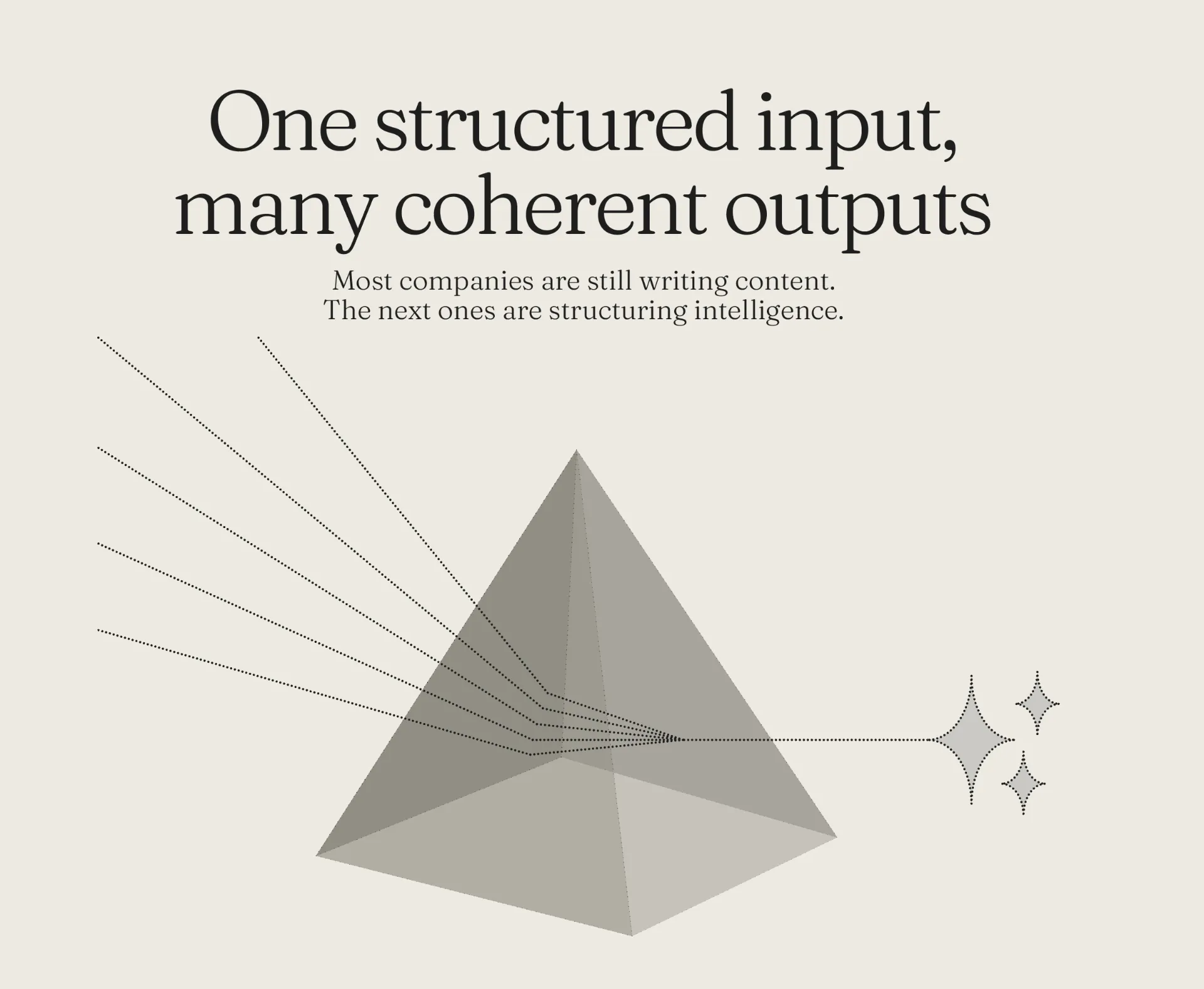
To prepare for AI, organizations need to rethink what content actually is. Not as documents, but as building blocks of meaning. Think in terms of: claims, truths, examples, use cases or personas. Each piece should be explicit, structured, and reusable.
Where this becomes real
Consider what happens when you generate:
- A sales proposal
- A conversational bot answer
- A hyper-personalized landing page
- A podcast script
- A pricing explanation
You’re not just generating text. You’re activating your internal knowledge layer. If that layer is messy, your AI output will be messy. If that layer is structured, your AI becomes reliable.
The missing layer
Structure alone isn’t enough. Meaning always depends on context:
- Who is it for?
- What tone should be used?
- What constraints apply?
- What is current?
Without governance, structured content is still unstable. This is where asset intelligence comes in, not as storage, but as orchestration.
The pattern completes
The first shift was about meaning. The second shift was about structure. The third shift is about governance. When these three come together:
Content stops being output. It becomes input infrastructure.
The return
Understanding is the new visibility. Governed understanding is the new advantage. Because in the age of AI: Content becomes the interface to intelligence. And performance becomes the feedback loop that refines it.